Real change begins at the community level; making our work with Philippine Local Government Units (LGUs) both crucial and timely.
Comprising of provinces, cities, municipalities, and barangays (villages or districts), LGUs are the critical link between national policy and local impact. They bear the essential responsibility of adapting national planning frameworks to fit the specific socio-economic and geographic contexts of their jurisdictions. Because they operate directly on the ground, LGUs are uniquely positioned to translate high-level climate targets into practical action; making their role in deploying renewable energy and energy efficiency initiatives absolutely vital.

The Sustainable Energy Planning for Local Government Units (SEP4LGUs), a project of the Southeast Asia Energy Transition Partnership (ETP), recognizes this role and seeks to empower LGUs by developing a pilot training program for local energy planning. It envisions the Local Government Academy (DILG-LGA), a Department of Interior and Local Government (DILG) attached agency for human resource development and training of LGUs, as the primary learning hub for local sustainable energy planning.
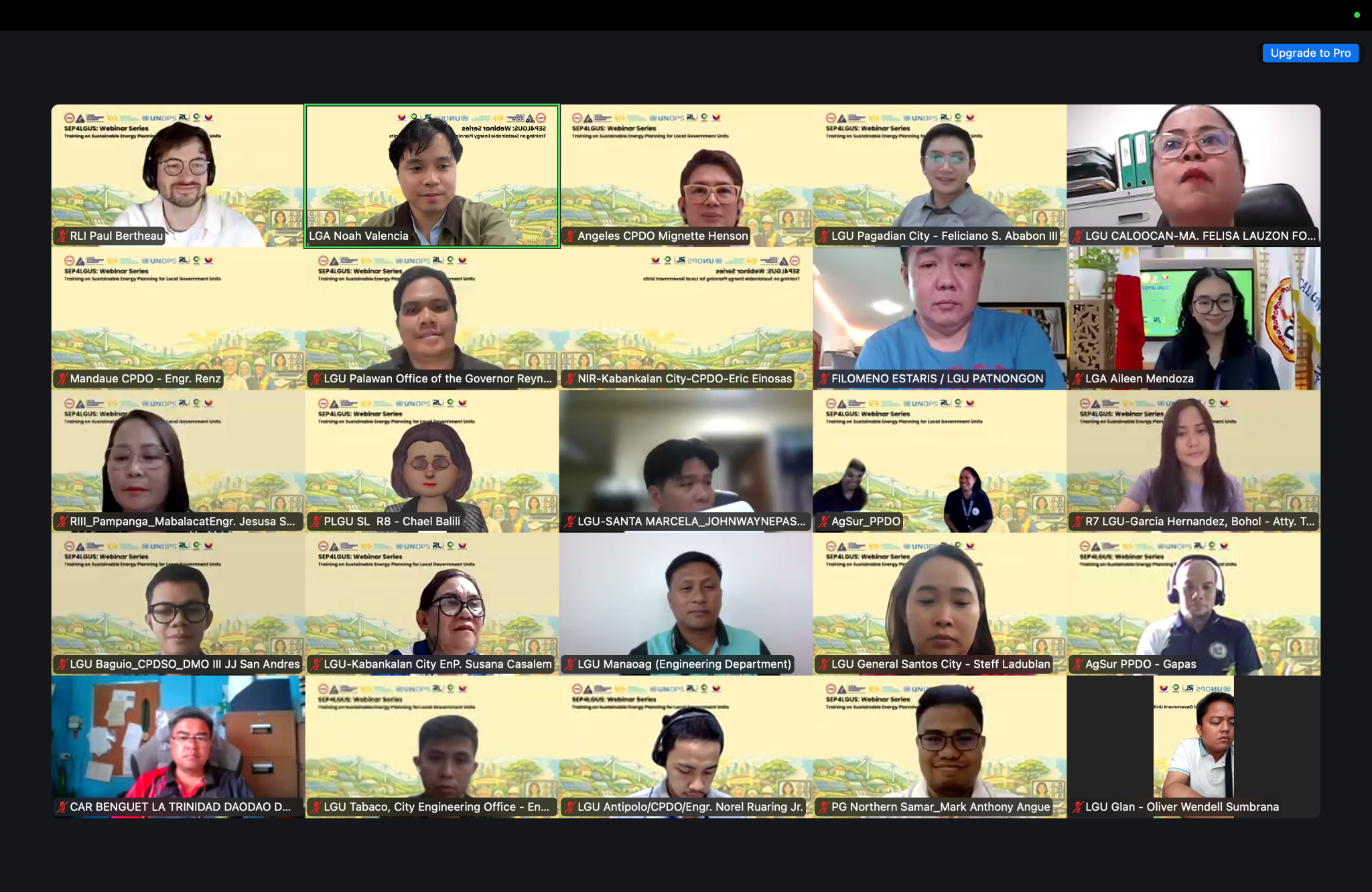
Over 450 participants from local government units (LGUs) across the Philippines gathered online to participate in a training program for sustainable energy planning at the local level. The recently concluded three-session webinar series is the first phase of the project’s pilot training program. It covered important energy planning concepts from the national energy planning framework to renewable energy solutions for LGUs. Implemented by the Reiner Lemoine Institut gGmbH (RLI) and Center for Empowerment, Innovation, and Training on Renewable Energy (CentRE), the SEP4LGUs project aims to institutionalize energy planning as a core competency of LGUs by integrating the pilot project into DILG-LGA’s capacity development programs.
Energy Planning as a Core Development Agenda
The webinar series began with various messages of support from key government partners such as the DILG-LGA represented by Executive Director Thelma T. Vecina, CESO III, DILG represented by Undersecretary for Local Government Marlo L. Iringan, and Department of Energy (DOE) with a keynote speech from DOE Secretary Sharon S. Garon delivered by DOE Undersecretary Felix William B. Fuentebella, highlighting the evolving energy landscape and the role of LGUs.
Following the various messages of support from DILG-LGA, DILG, ETP, and DOE, Undersecretary Fuentebella presented the national energy policies and programs and its implications to local energy planning.
The presentation emphasized that local energy planning can be utilized to bring more development in their localities as it allows for investment opportunities and strengthens resilience amidst disasters. In order to facilitate this, the DOE has a number of initiatives for local energy planning including mandates for a Local Energy Efficiency and Conservation Plan (LEECP) and Government Energy Management Program (GEMP) under the Energy Efficiency and Conservation Act.

Furthermore, the LGU Energy Code was highlighted as the center of local energy planning which serves as an enabling policy for key areas of energy planning such as energy efficiency and conservation initiatives, streamlining local permitting processes, and the development of renewable energy projects.
The first session showcased three LGUs with established energy planning practices. The Quezon City Climate Change and Environmental Sustainability Department Officer-in-Charge Vanessa Claire Vinarao and City Engineering Department Engineer Anthony Lopos presented their Enhanced Local Climate Change Action Plan, the primary comprehensive plan governing the city’s decarbonization strategy and its extensive solarization program.

Providing experience from the island of Mindanao were presentations from the Province of Surigao del Sur and Butuan City. A video from Surigao del Sur Governor Johnny T. Pimentel outlined key programs under its Sustainable Energy Code such as the Provincial Green Fund and Provincial Renewable Energy Zones. Following this was a recorded presentation from Butuan City Vice Mayor Renante B. Desiata and additional input from Assistant City Planning and Development Coordinator Engineer Jake Dumpasan highlighting the Butuan City Energy Development Plan (BEDP) 2023-2050 which institutionalizes its target of net zero emissions by 2050.
With all the plans shared and the programs that implement their targets, the experiences of these LGUs exemplified that the key to sustainable energy planning is understanding its intersections with the community’s development agenda.
Practical Tools for Energy Efficiency and Conservation (EEC)
Supplementing this discussion, Director of Center for Renewable Energy and Appropriate Technologies of Ateneo de Davao University and the Center Manager of the Mindanao Renewable Energy R&D Center Dr. Nelson Enano Jr. presented strategies for implementing EEC initiatives at the local level and the importance of the LEECP. Dr. Enano provided a roadmap development framework to equip LGUs with a clear starting point for their EEC programs.

Province of Iloilo Board Member Rolly Distura shared the Province of Iloilo’s Renewable Energy Roadmap emphasizing practical solutions for LGUs by integrating energy planning into local governance processes. Through the various policies enacted by Iloilo, the Province designated EEC LGU personnel and ensured regular funding for sustainable energy initiatives in their province. BM Distura emphasized the importance of these components to institutionalize RE and EEC in their local practices.
To conclude the session, the participants engaged in an open forum with EEC Public Sector Management Division Officer-in-Charge Supervising Science Research Specialist Anabel M. Elmaga who addressed key questions related to monitoring energy consumption, energy savings, and the DOE’s available technical assistance.
Renewable Energy (RE) Solutions for LGUs

In the final session, the participants learned about national renewable energy programs and practical experiences on how RE is used on the ground. DOE Undersecretary Mylene C. Capongcol provided an overview of key RE policies and the role of LGUs in various parts of RE development. With the Philippines shifting to more sustainable energy options, Undersecretary Capongcol emphasized the greater role of LGUs as active energy planners.
Following this were presentations from LGUs who use RE on the ground for various development needs.

Provincial Consultant on Energy and Environmental Concerns and Former Governor of Negros Occidental Rafael “Lito” Coscolluela presented SecuRE NEGROS, the province’s Power Development Roadmap with Transition to RE. This lays out the province’s plan to power energy security through 100% RE in Negros Occidental.
Sharing experience from the barangay level, Santiago City’s Barangay General Malvar Barangay Captain Manuel “Sonny” G. Santiago II presented their Solar Power Revolution program which harnessed solar power to improve peace and security and disaster risk mitigation.
These local leaders in energy planning illustrate the unique position of LGUs. As government entities closest to communities, LGUs can harness energy planning and align it with their development needs to open pathways for sustainable economic progress. The growing interest from LGUs and local pioneers signify that the Philippine energy transition calls for greater local participation. To achieve this, it is essential that LGUs have the necessary support to create and commit to these plans through key institutional resources such as the DILG-LGA’s capacity development programs.
The SEP4LGUs project will deepen its efforts through the next phase dedicated to targeted technical training on sustainable energy planning for select LGUs.

About the Author
Liana Fernando is a Program Management Intern for the Philippines portfolio of the Southeast Asia Energy Transition Partnership (ETP) at the United Nations Office for Project Services (UNOPS). She earned her bachelor’s degree in Political Science with a Minor in Development and the Law from the Ateneo de Manila University. Currently, Liana is pursuing a Master in Public Management at the Ateneo School of Government to further her interests in inclusive and participatory governance policy..