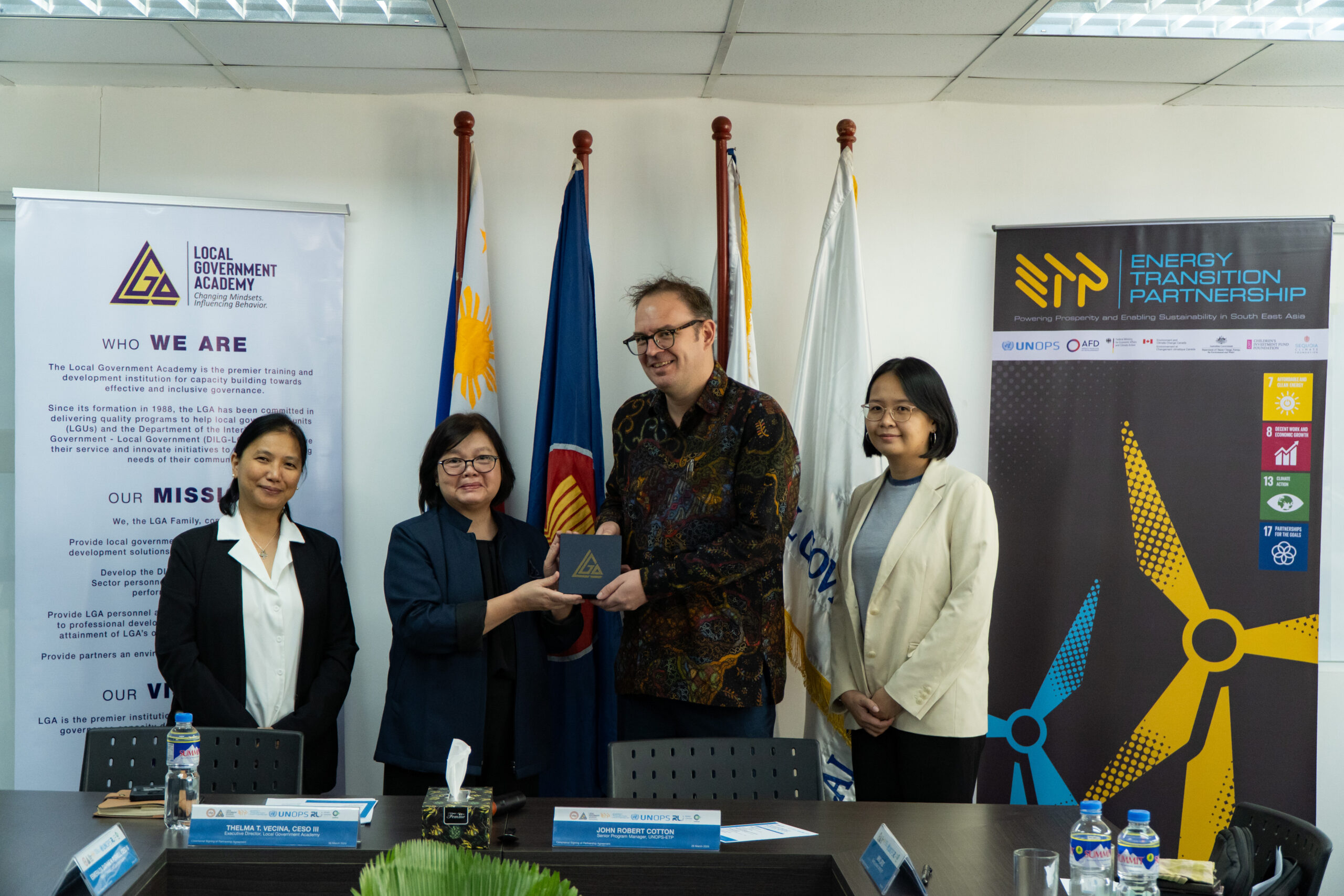
We wrapped up the month of March (26) with a timely ceremonial signing between the Department of Interior and Local Government – Local Government Academy (DILG-LGA) and the United Nations Office for Project Services (UNOPS) Southeast Asia Energy Transition Partnership (ETP) solidifying our ongoing partnership. The partnership is in line with ETP’s new project with DILG-LGA titled Sustainable Energy Planning for Local Government Units (LGUs) in the Philippines, a project implemented by the Reiner Lemoine Institut (RLI) and Center for Empowerment, Innovation, and Training on Renewable Energy (CentRE).

DILG-LGA Executive Director Thelma T. Vecina launched the event acknowledging the relevance of the project amidst the State of National Energy Emergency in the Philippines, underscoring the growing urgency of strengthening local capacities amid evolving energy and governance challenges. She emphasized a shift within local government units (LGUs) towards more proactive, participatory, and forward-looking governance which require sustained capacity development in enabling LGUs to respond effectively to emerging challenges. Operation LISTO, a key program under DILG-LGA, addresses this by providing capacity development activities for Disaster Risk Reduction and Management – Climate Change Adaptation and Mitigation (DRRM-CCAM) creating resilient local governments amidst disasters. One of the key components of Operation LISTO is dedicated to enhancing the integration of risk information in local planning and budgeting processes. The project contributes to this by equipping LGUs with skills on energy efficiency and conservation measures and utilization of local renewable energy resources. This provides LGUs with the capacity to identify solutions for local energy reliability and security; building resilience against disruptions in the energy supply chain.
In closing, Executive Director Vecina underscored the importance of partnerships, such as this, in ensuring capacity development is delivered efficiently, urgently, and at scale, ensuring that no LGU or Filipino is left behind.


This perspective was complemented by ETP Senior Program Manager John Robert Cotton who framed the energy transition as a strategic imperative tied to national resilience and sovereignty. He highlighted the vast renewable energy resources in the Philippines and its greater role in securing stable and reliable energy systems.
These messages reinforce the importance of advancing local energy planning and strengthening the role of LGUs in championing the energy transition. Through the Sustainable Energy Planning for Local Government Units (LGUs) in the Philippines Project, LGUs can become key drivers of a more resilient and energy secure Philippines.
ETP’s Intervention: Sustainable Energy Planning for Local Government Units (LGUs) in the Philippines Project

The project aims to strengthen the capacity of DILG-LGA as the primary learning hub for sustainable energy planning for local government officials at various levels. This technical assistance establishes a pilot training on sustainable energy planning, supported by a network of knowledge partners that can sustain or augment the program in the long run. It is envisioned that the pilot program will be housed under DILG-LGA’s Operation LISTO, a disaster preparedness program for LGUs.
Once delivered at scale, the training will enable LGUs to develop energy plans, programs, and activities and integrate them into key local planning instruments, including local economic development plans, annual investment plans, and climate action plans. In doing so, clean energy planning can be mainstreamed in local planning and development; opening local markets for renewables, accelerating the adoption of energy efficiency and demand side management solutions, facilitating the approval of utility-scale renewable energy projects, and strengthening local policy support for the country’s energy transition.